5  Maps

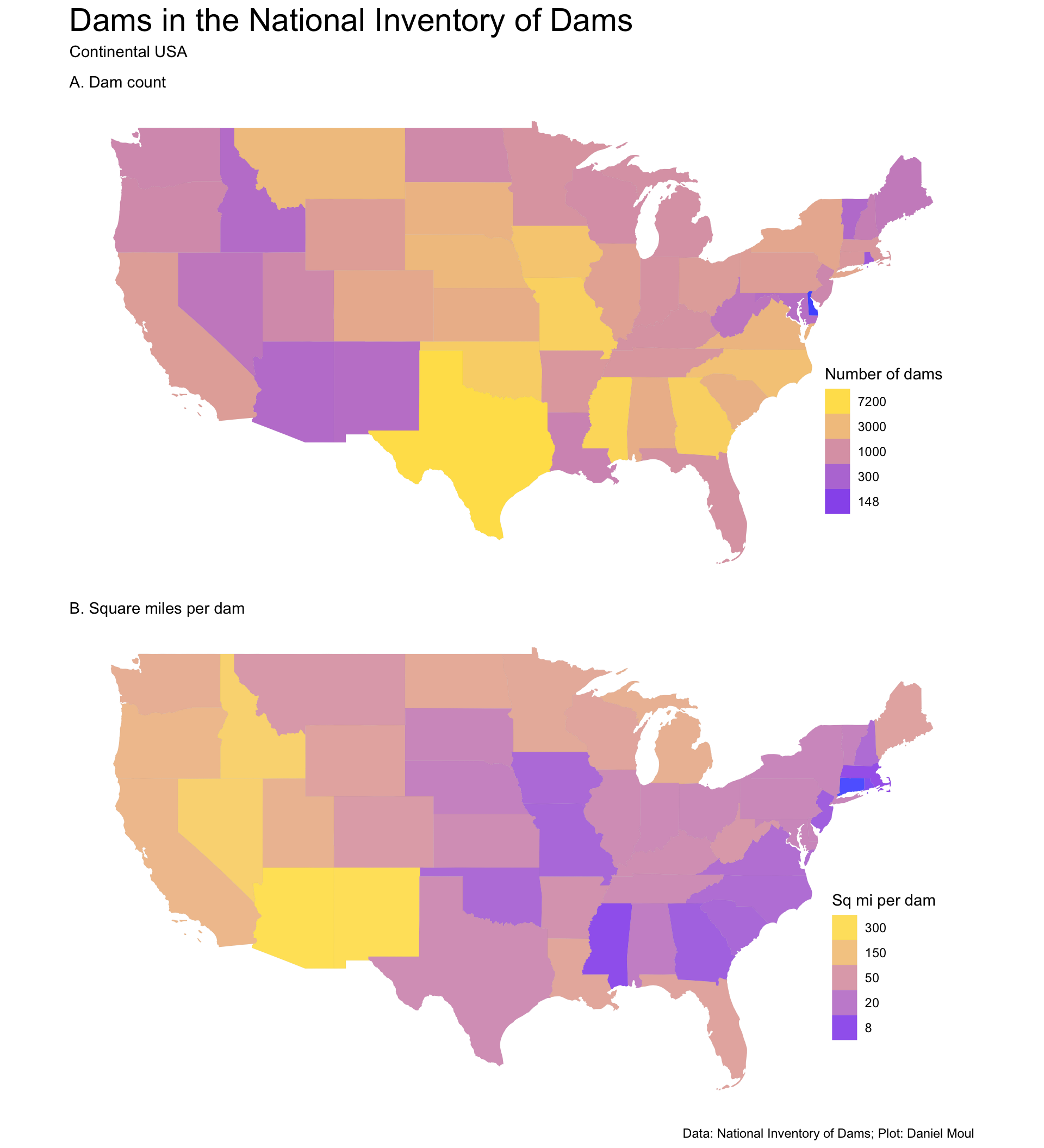
Let’s start with two choropleth maps: Figure 5.1 shows number of dams and square miles per dam in each state. It’s a plot of 86,351 dams in the National Inventory of Dams (NID) in the continental USA.

Show the code
dta_for_plot <- state_boundaries_sf |>
  left_join(dams_by_state |>
              st_drop_geometry(),
            by = join_by(state_abb)) |>
  # Should I include water as well as land in the state area calc below? As long as I'm consistent either is OK.
  mutate(state_area_mi2 = (aland + awater) / 2589988.110336,  # convert from m^2 to mi^2
         dams_per_mi2 = n / state_area_mi2,
         mi2_per_dam = state_area_mi2 / n
  )

dta_for_plot |>
  st_drop_geometry() |>
  arrange(desc(n)) |>
  head(5) |>
  select(state_abb, n) |>
  gt() |>
  tab_header(md("**States with the most dams**"))
States with the most dams
state_abb n
TX 7279
MS 6088
MO 5378
GA 5356
OK 4970


States with the fewest dams are small (NJ, RI, VT) or very dry (ID, AZ, NM). States with the most dams are wet, large and/or had a compelling need for flood control (MS, GA, TX, MO).

The states with the fewest square miles per dam come from New England states (CT, RI, MA) and (because there are so many dams: MS). The dry states in the west (ID, NV, AZ, NM) have the most square miles per dam:

Show the code
p1 <- dta_for_plot |>
  ggplot() +
  geom_sf(aes(fill = n),
          size = 0.01,
          color = "grey50",
          alpha = 0.75) +
  scale_fill_gradient(trans = "log",
                     low = "blue",
                     high = "gold",
                     breaks = c(148, 300, 1000, 3000, 7200) # set manual breaks to get "clean" numbers
                     ) +
  guides(fill = guide_legend(
    reverse = TRUE,
    position = "inside")) +
  theme(axis.text = element_blank(),
        axis.ticks = element_blank(),
        axis.title = element_blank(),
        legend.position.inside = c(0.9, 0.3)) +
  labs(
    subtitle = "A. Dam count",
    fill = "Number of dams"
  )

p2 <- dta_for_plot |>
  ggplot() +
  geom_sf(aes(fill = mi2_per_dam),
          size = 0.01,
          color = "grey50",
          alpha = 0.7) +
  scale_fill_gradient(trans = "log",
                     low = "blue",
                     high = "gold",
                     breaks = c(8, 20, 50, 150, 300) # set manual breaks to get "clean" numbers
                     ) +
  guides(fill = guide_legend(
    reverse = TRUE,
    position = "inside")) +
  theme(axis.text = element_blank(),
        axis.ticks = element_blank(),
        axis.title = element_blank(),
        legend.position.inside = c(0.9, 0.3)) +
  labs(
    subtitle = "B. Square miles per dam",
    fill = "Sq mi per dam"
  )

p1 / p2 +
  plot_annotation(
    title = "Dams in the National Inventory of Dams",
    subtitle = "Continental USA",
    caption = my_caption
  )
Figure 5.1: Maps of dams in the continental states colored by number of dams and square miles per dam in each state


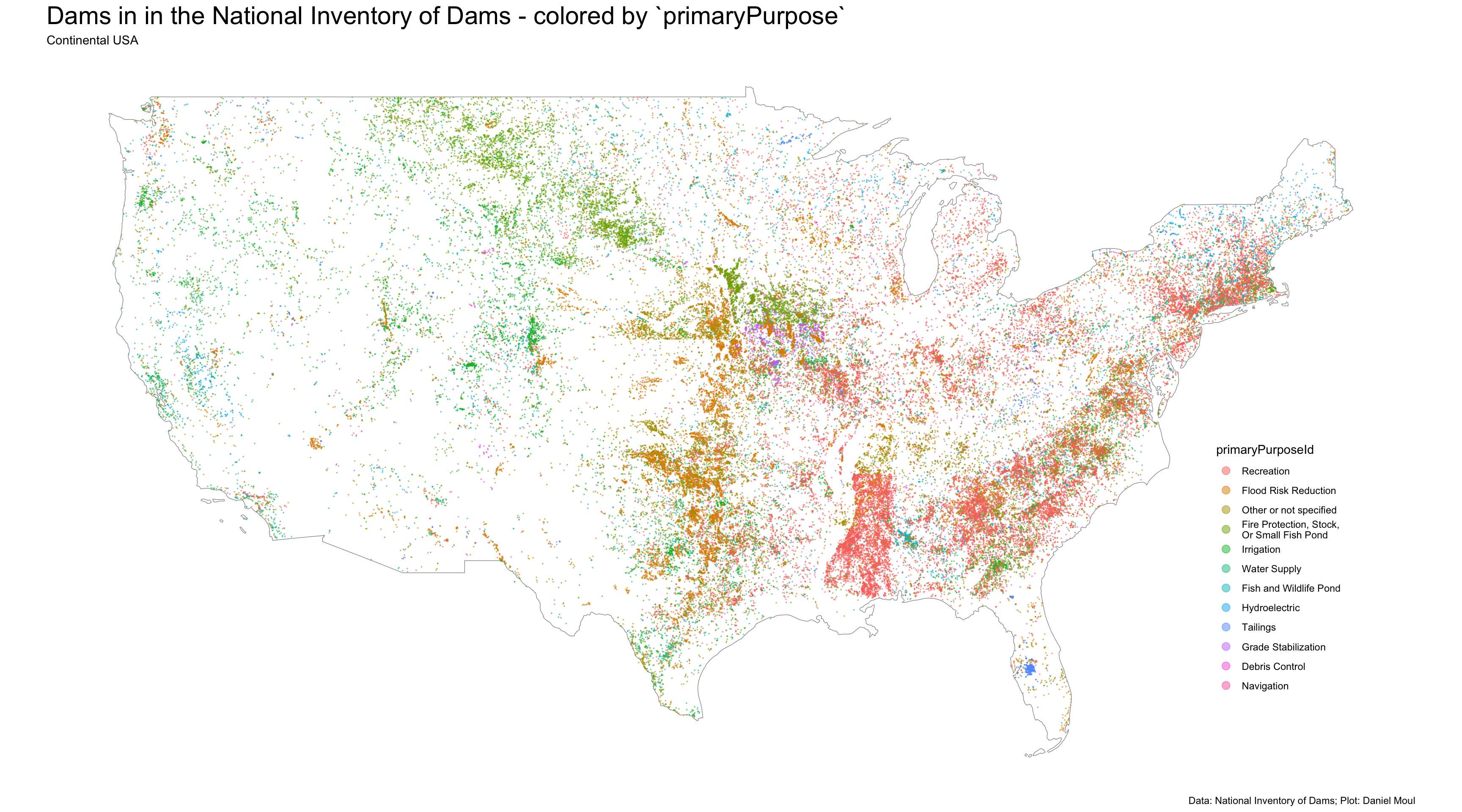
Plotting dam locations colored by purpose in Figure 5.2, even without showing state state borders, we can see some regional and state differences1:

Show the code
ggplot() +
  geom_sf(data = continental_us_border, # state_boundaries_sf, 
          fill = NA,
          color = "grey50") +
  geom_sf(data = dams |>
            mutate(n_primaryPurposeId = n(),
                   .by = primaryPurposeId) |>
            mutate(primaryPurposeId = fct_reorder(primaryPurposeId, -n_primaryPurposeId)),
          aes(color = primaryPurposeId),
          size = 0.01,
          alpha = 0.5) +
  guides(color = guide_legend(override.aes = list(size = 3),
                              position = "inside")) +
  theme(axis.text = element_blank(),
        axis.ticks = element_blank(),
        axis.title = element_blank(),
        legend.position.inside = c(0.9, 0.3)) +
  labs(
    title = "Dams in in the National Inventory of Dams - colored by `primaryPurpose`",
    subtitle = "Continental USA",
    caption = my_caption
  )
Figure 5.2: Map of dams in the continental states colored by primaryPurpose


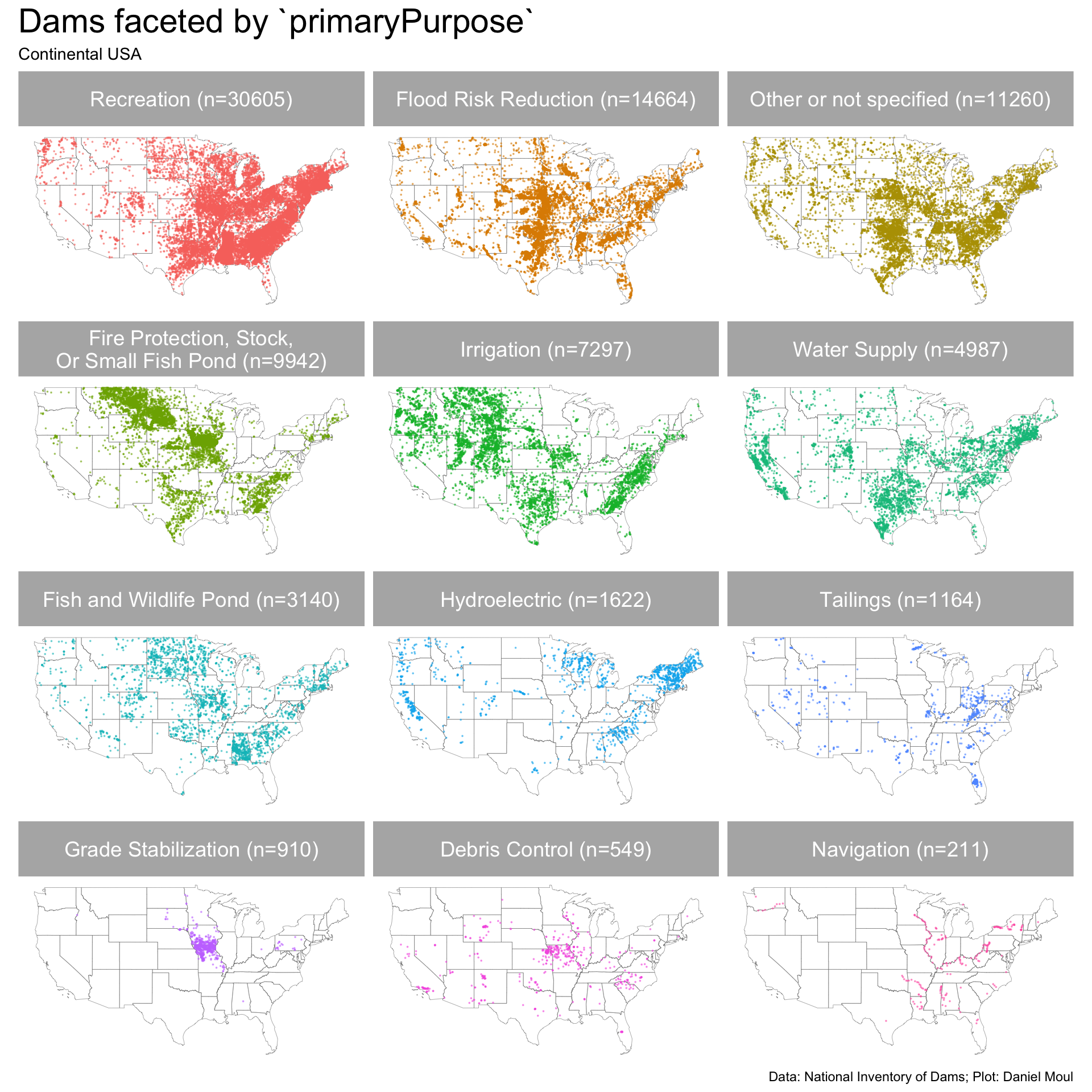
Figure 5.3 makes the clusters by region and state easier to see.

Show the code
ggplot() +
  geom_sf(data = state_boundaries_sf,
          color = "grey50",
          linewidth = 0.1,
          fill = NA) +
  geom_sf(data = dams |>
            mutate(n_primaryPurposeId = n(),
                   .by = primaryPurposeId) |>
            mutate(primaryPurposeId_label = glue("{primaryPurposeId} (n={n_primaryPurposeId})"),
                   primaryPurposeId_label = fct_reorder(primaryPurposeId_label, -n_primaryPurposeId)),
          aes(color = primaryPurposeId_label),
          size = 0.01,
          alpha = 0.5) +
  guides(color = "none") +
  facet_wrap( ~ primaryPurposeId_label, ncol = 3) +
  theme(axis.text = element_blank(),
        axis.ticks = element_blank(),
        axis.title = element_blank()) +
  labs(
    title = "Dams faceted by `primaryPurpose`",
    subtitle = "Continental USA",
    caption = my_caption
  )
Figure 5.3: Map of dams in the continental USA by primaryPurpose


5.1 Dams by height

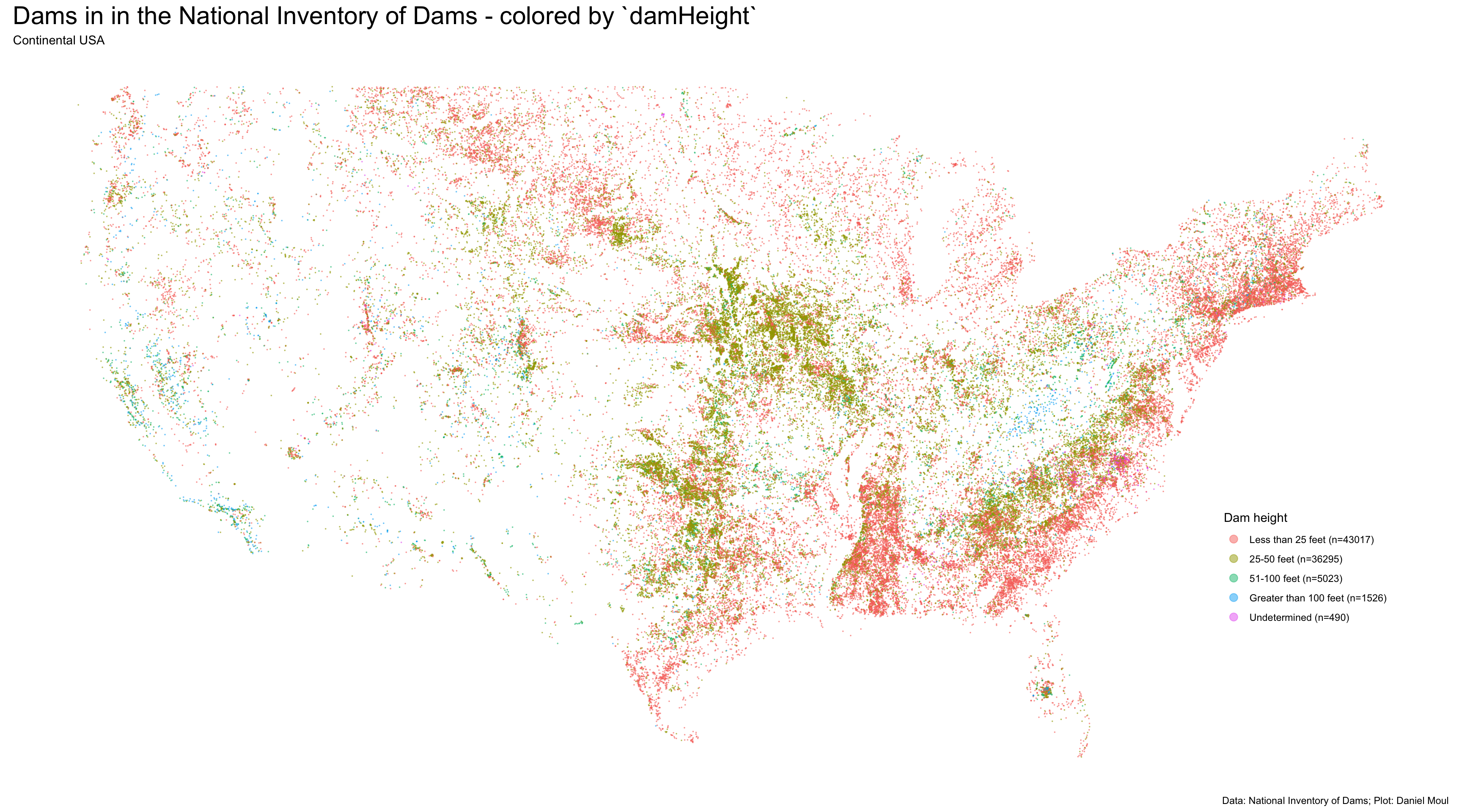
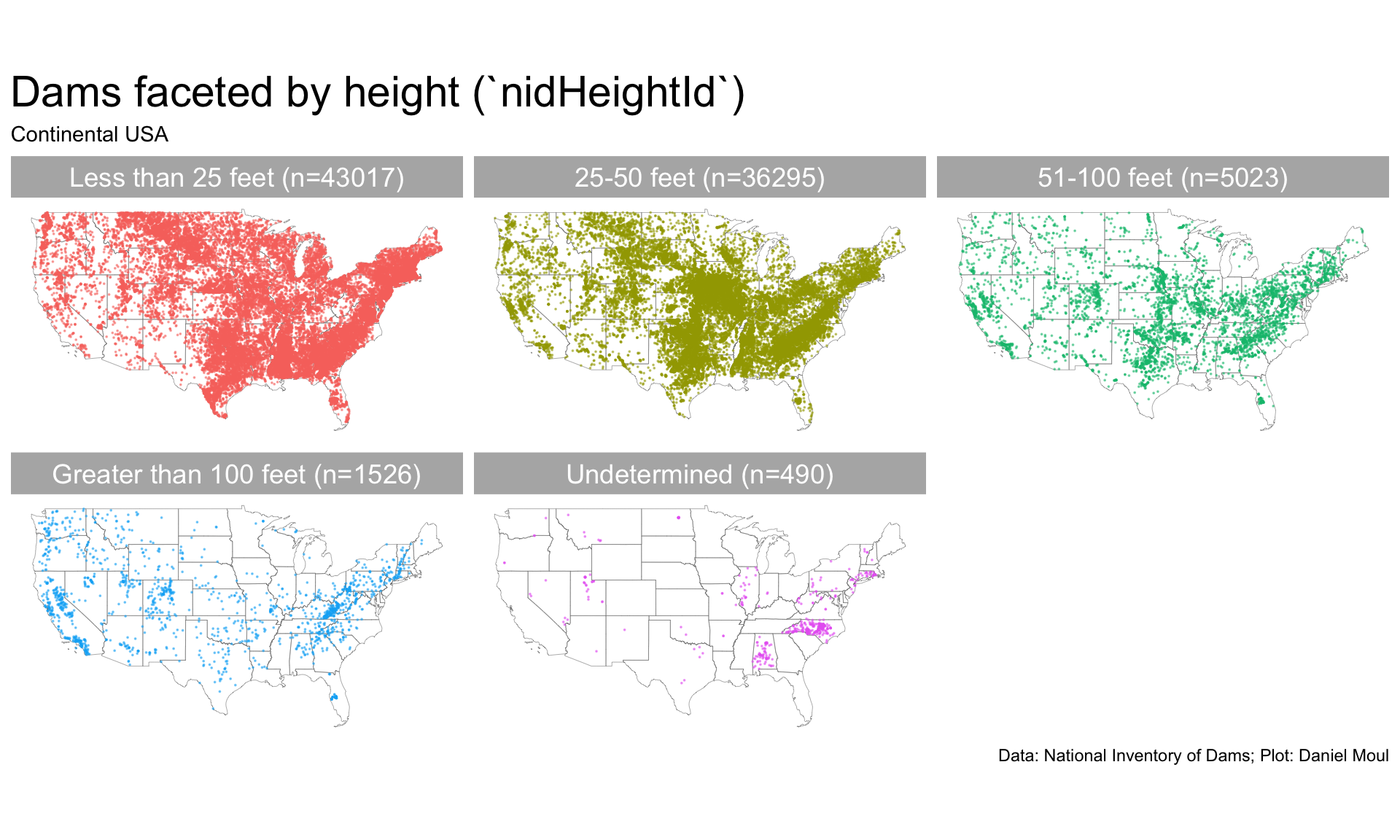
A similar map colored by damHeight (Figure 5.4) makes visible other patterns:

  • There are a lot of small dams < 25 ft high along the east coast and in the north central and north east.
  • There is a cluster of big dams in and around the Tennessee Valley and in the Sierra Nevada mountains of California.
Show the code
dta_for_plot <- dams |>
            mutate(n_nidHeightId = n(),
                   .by = nidHeightId) |>
            mutate(nidHeightId_label = glue("{nidHeightId} (n={n_nidHeightId})"),
                   nidHeightId_label = fct_reorder(nidHeightId_label, -n_nidHeightId))

ggplot() +
  geom_sf(data = dta_for_plot,
          aes(color = nidHeightId_label),
          size = 0.01,
          alpha = 0.5) +
  guides(color = guide_legend(override.aes = list(size = 3),
                              position = "inside")) +
  theme(axis.text = element_blank(),
        axis.ticks = element_blank(),
        axis.title = element_blank(),
        legend.position.inside = c(0.9, 0.3)) +
  labs(
    title = "Dams in in the National Inventory of Dams - colored by `damHeight`",
    subtitle = "Continental USA",
    caption = my_caption,
    color = "Dam height"
  )
Figure 5.4: Map of dams colored by damHeight in the continental states


Again the same information faceted (Figure 5.5) make some patterns easier to see.

Show the code
ggplot() +
  geom_sf(data = state_boundaries_sf,
          color = "grey50",
          linewidth = 0.1,
          fill = NA) +
  geom_sf(data = dta_for_plot,
          aes(color = nidHeightId_label),
          size = 0.01,
          alpha = 0.5) +
  guides(color = "none") +
  facet_wrap( ~ nidHeightId_label, ncol = 3) +
  theme(axis.text = element_blank(),
        axis.ticks = element_blank(),
        axis.title = element_blank()) +
  labs(
    title = "Dams faceted by height (`nidHeightId`)",
    subtitle = "Continental USA",
    caption = my_caption
  )
Figure 5.5: Map of dams in the continental USA by damHeight


5.2 Big dams

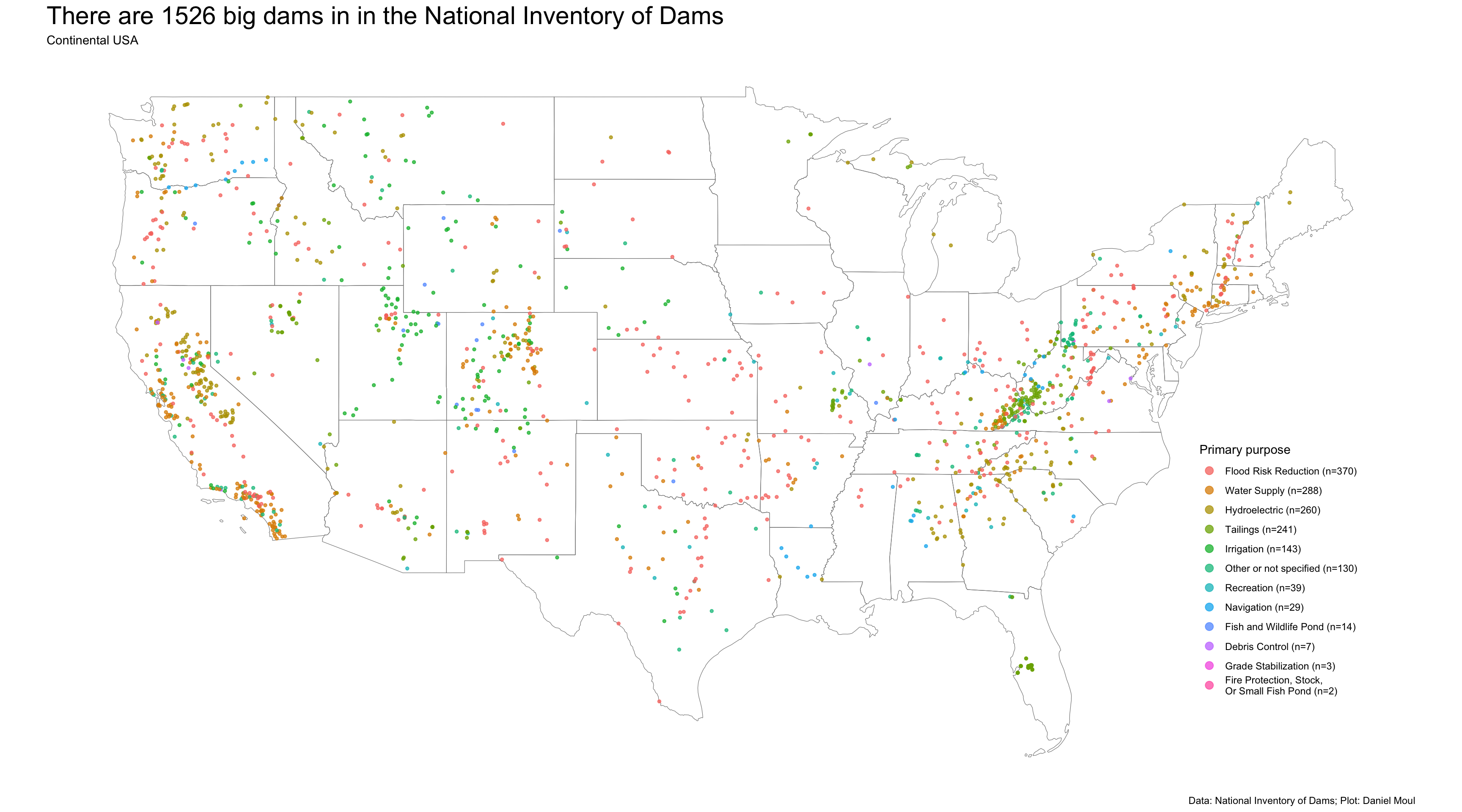
The NID categorizes dams by height in nidHeightId. The tallest category includes dams that are more than 100 ft high. Let’s call them “big dams”.

Show the code
n_big_dams <- dams |>
  filter(big_dam) |>
  nrow()

ggplot() +
  geom_sf(data = state_boundaries_sf,
          color = "grey50",
          fill = NA) +
  geom_sf(data = dams |>
            filter(big_dam) |>
            mutate(n_primaryPurposeId = n(),
                   .by = primaryPurposeId) |>
            mutate(primaryPurposeId = glue("{primaryPurposeId} (n={n_primaryPurposeId})"),
                   primaryPurposeId = fct_reorder(primaryPurposeId, -n_primaryPurposeId)),
          aes(color = primaryPurposeId),
          size = 1,
          alpha = 0.75) +
  guides(color = guide_legend(override.aes = list(size = 3),
                              position = "inside")) +
  theme(axis.text = element_blank(),
        axis.ticks = element_blank(),
        axis.title = element_blank(),
        legend.position.inside = c(0.9, 0.3)) +
  labs(
    title = glue("There are {n_big_dams} big dams in in the National Inventory of Dams"),
    subtitle = "Continental USA",
    caption = my_caption,
    color = "Primary purpose"
  )
Figure 5.6: Map of big dams in the continental USA


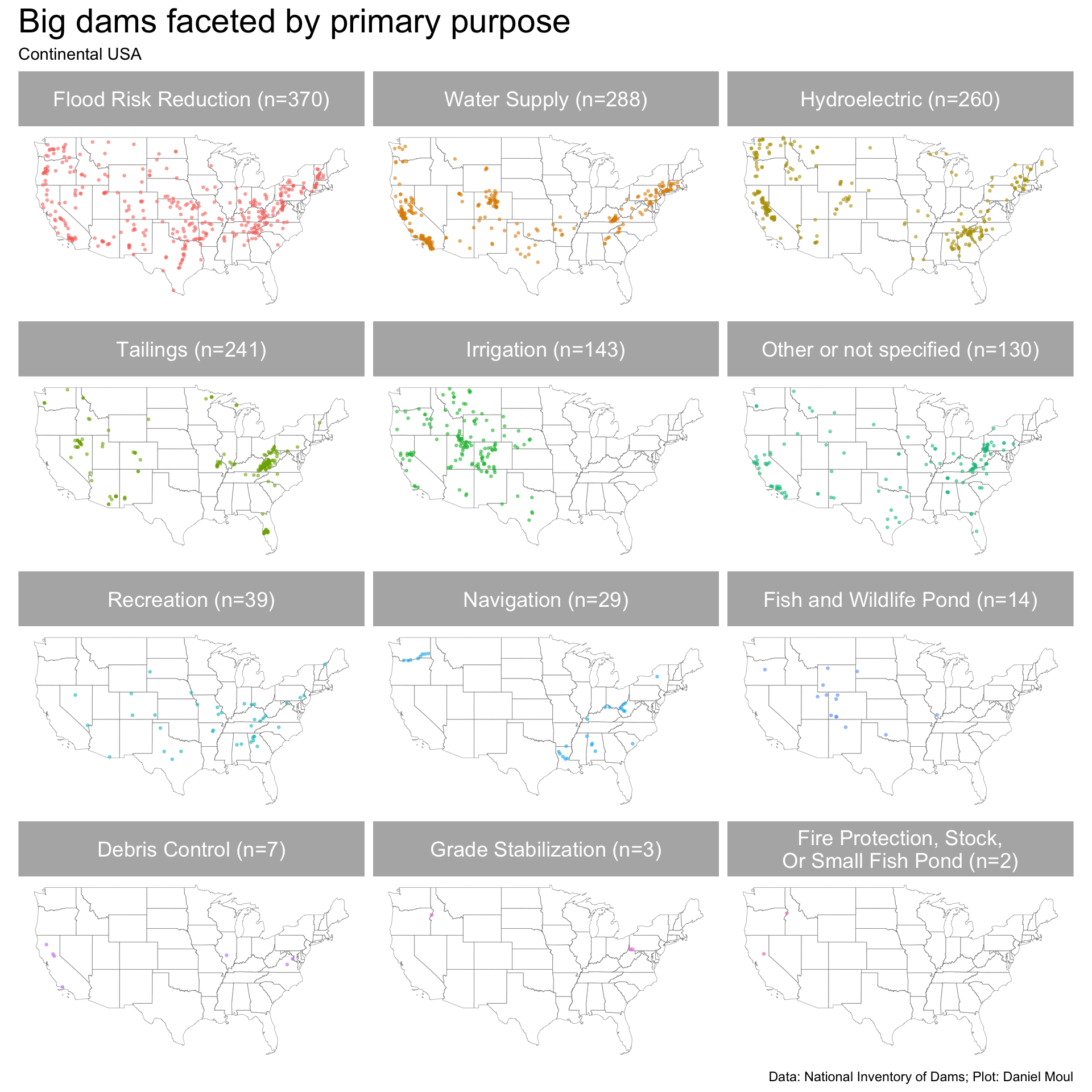
Faceting by their primaryPurpose (Figure 5.7) makes the patterns easier to see.

Show the code
dta_for_plot <- dams |>
            filter(big_dam) |>
            mutate(n_primaryPurposeId = n(),
                   .by = primaryPurposeId) |>
            mutate(primaryPurposeId_label = glue("{primaryPurposeId} (n={n_primaryPurposeId})"),
                   primaryPurposeId_label = fct_reorder(primaryPurposeId_label, -n_primaryPurposeId))

ggplot() +
  geom_sf(data = state_boundaries_sf,
          color = "grey50",
          linewidth = 0.1,
          fill = NA) +
  geom_sf(data = dta_for_plot,
          aes(color = primaryPurposeId_label),
          size = 0.5,
          alpha = 0.5) +
  guides(color = "none") +
  facet_wrap( ~ primaryPurposeId_label, ncol = 3) +
  theme(axis.text = element_blank(),
        axis.ticks = element_blank(),
        axis.title = element_blank()) +
  labs(
    title = "Big dams faceted by primary purpose",
    subtitle = "Continental USA",
    caption = my_caption
  )
Figure 5.7: Map of big dams by primary purpose


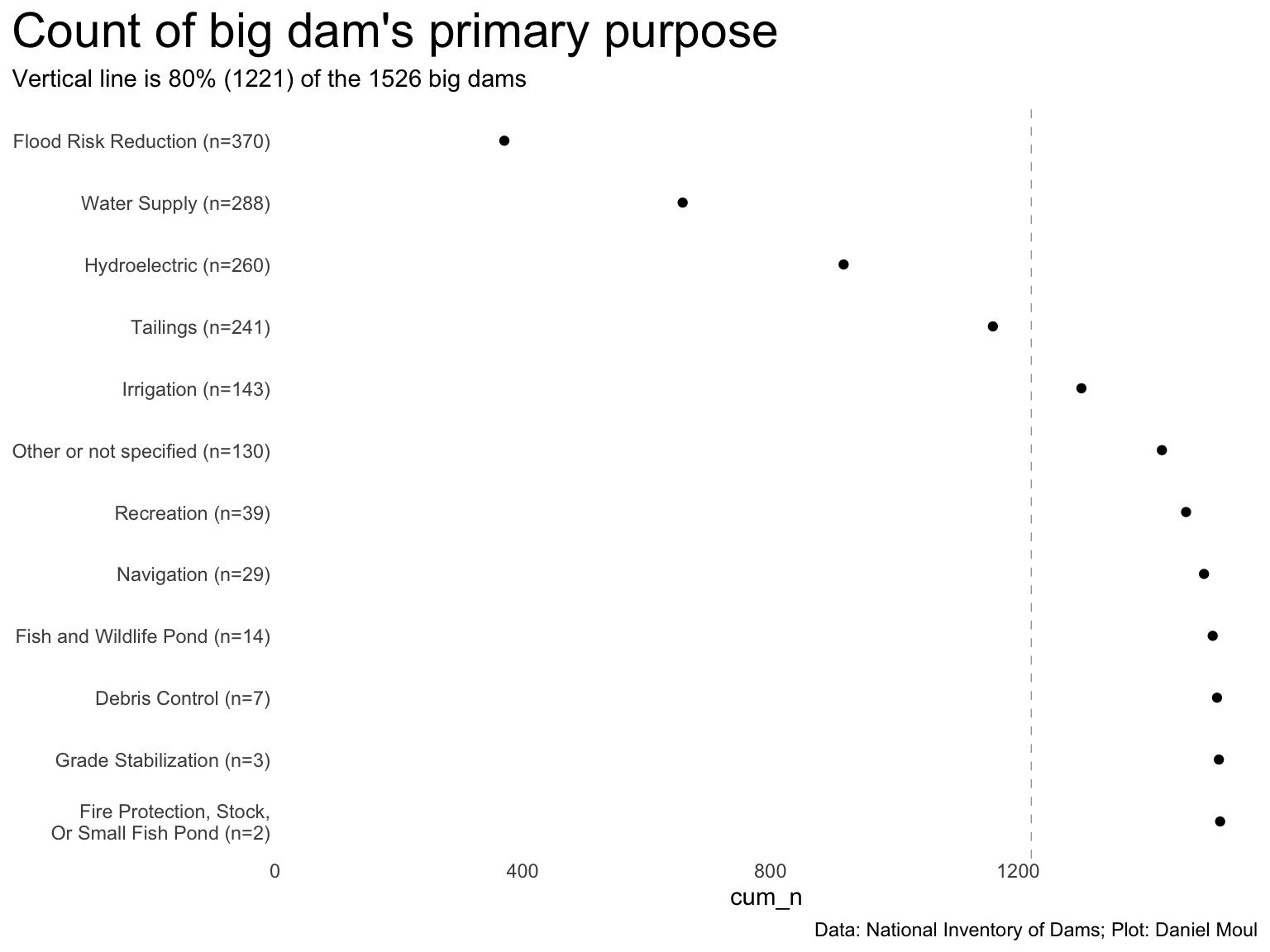
Most of the big dams (Figure 5.8) are primarily for flood risk reduction, water supply, hydroelectric power, and to hold mine tailings.

Show the code
dta_for_plot2 <- dta_for_plot |>
  distinct(primaryPurposeId_label, n_primaryPurposeId)

n_dams <- sum(dta_for_plot2$n_primaryPurposeId)
pct80 <- round(n_dams * 0.8)

dta_for_plot2 |>
  arrange(desc(n_primaryPurposeId)) |>
  mutate(primaryPurposeId_label = fct_reorder(primaryPurposeId_label, n_primaryPurposeId),
         cum_n = cumsum(n_primaryPurposeId)) |>
  ggplot(aes(cum_n, primaryPurposeId_label, group = cum_n)) +
  # geom_line() +
  geom_vline(xintercept = pct80,
             lty = 2, linewidth = 0.2, alpha = 0.5) +
  geom_point() +
  scale_x_continuous(expand = expansion(mult = c(0, 0.04))) +
  expand_limits(x = 0) +
  theme(plot.title.position = "plot") +
  labs(
    title = "Count of big dam's primary purpose",
    subtitle = glue("Vertical line is 80% ({pct80}) of the {n_dams} big dams"),
    y = NULL,
    caption = my_caption
  )
Figure 5.8: Map of big dams in the continental USA


There are more insights to be gleaned by looking at other numerical distributions and summaries. That’s the focus of the next chapter.


  1. Some differences may be due to differences in state-level policies related to data collection than to the number of dams; others may be due to geographical differences, since it was common to put borders where the geography changes.↩︎